










Writing About Writing
With Author Ben Merrill
Words By Paige Glazer

Writing is hard. There. I said it. I realize that may be an odd confession from someone whose name has appeared beneath the words publisher and editor for a good portion of her adult life. But if you had seen the red ink on some of my college essays, you might find my career path every bit as amusing as I do.
I did not grow up dreaming of becoming a writer. Reading was something teachers assigned. Writing was something I had to do afterward to prove I had read it. Somehow—and I still consider this one of life’s great plot twists—I ended up publishing a magazine built almost entirely around telling stories.
Which means I spend a lot of time around writers. And I still don’t completely understand how they do it. Nonfiction I can wrap my head around. There is a person. There is a place. Something happened. You ask enough questions, listen carefully and eventually find the story hiding somewhere in all the answers. But fiction? There is nothing there. No interview. No old photograph. No historical record to dig through. A writer begins with a blank page and somehow creates people with childhoods, secrets, faults and desires. We root for them, become frustrated with them, forgive them and, if the writer has done his job particularly well, miss them when the story ends. How does somebody do that?
Ben Merrill seemed like a good person to ask. A few years ago, Ben sent me an email. He was fairly new to Richmond Hill, a transplant from the North who had discovered Reflections and wanted to be part of it. Ben had been writing most of his life. Born on Martha’s Vineyard and raised in Connecticut and Massachusetts, he graduated from Gordon College with a degree in English and journalism and spent the next four decades writing for newspapers, magazines, businesses and educational organizations. He moved to Richmond Hill in 2019 and began writing for Reflections the following year.
Since then, Ben has helped us tell the stories of this community—meeting its artisans, educators, tradespeople, law enforcement officers, business leaders and assorted characters along the way. He once told an interview subject how surprised he was by the warmth he encountered after moving South. Her response was simple: “That’s how we do it here.” Somewhere along the way, the Northerner who had never even stepped foot in Georgia before moving here stopped feeling like a transplant. “I’ve never once felt like a stranger down here,” Ben says.
And while Ben was helping tell the stories of our village, another village was apparently taking shape in his mind. It was called Stinson Creek. In 2026, Ben published his first novel, Murder and Redemption at Stinson Creek. I’ve enjoyed reading the book, but perhaps even more, I’ve enjoyed picking Ben’s brain on how he created it: the characters appeared, their personalities developed. A manuscript eventually became a book. The whole process left me increasingly fascinated by the strange business of writing fiction. Except Ben would probably correct me on one point. He doesn’t believe he created these people at all. “The characters in Murder and Redemption are very real to me,” he says. “I realized not too far into the book that I was not creating their story. I was simply telling it.” Well, now I had more questions.

Ben can actually pinpoint the moment it happened. He was writing an exchange between two characters when one of them began behaving very differently from the man Ben had originally imagined. Every time he tried to force the character in another direction, it felt wrong. At the same time, another character seemed to take complete ownership of his own personality. “I realized that I didn’t have any more creative control over Martin,” Ben says. “I saw him for who he was, and for the rest of the book, he did the things that Martin Pope would do. I didn’t have to create any of it.”
This, I admit, did absolutely nothing to clear things up for me. I wanted to know where fictional people came from, and Ben was telling me his fictional people wouldn’t even listen to him. “With each of these characters, I had an idea in my head who I wanted them to be, and why, but they fairly quickly took on—and took over—their own personalities,” he explains. “Once that happened, I became less their creator and more their storyteller.”
Maybe his years as a journalist had prepared him for that more than he realized. Journalists begin interviews with assumptions all the time. You think you understand someone before you sit down with them, only to discover the person in front of you is more complicated, more interesting or simply different from what you expected. His words, not mine. “I have to write them as they are, not as I wish they were.”
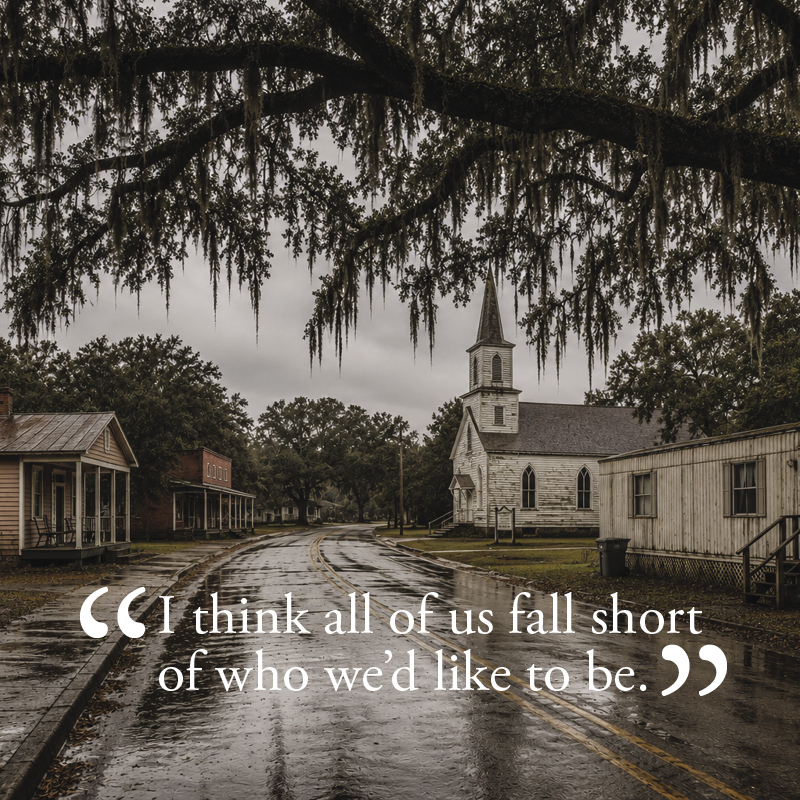
That unpredictability became part of the book. Characters changed in ways Ben had not anticipated. Some grew softer. Some stronger. Some found a kind of redemption. “They embodied a kind of redemption I think is possible for all of us,” he says. Ben’s characters are flawed. They regret things. They make choices they cannot undo. They disappoint others and themselves. In other words, they are human. “For my characters to be human, they have to be flawed,” says Ben. “I think all of us fall short of who we’d like to be.”
The place itself grew from something very real. Not long after moving South, Ben was driving Route 17 toward Charleston when he passed an abandoned church and several boarded-up houses. He could not stop thinking about them. At some point, people had lived there. They had loved, grieved, kept secrets and carried regrets. Where had they gone? Were they really gone at all? “Something in me just felt like someone needed to tell the story of that abandoned church and those boarded-up houses on Route 17,” Ben says. And so, in a way, Stinson Creek began.
The landscape surrounding it was easier to find. Coastal Georgia had already gotten under Ben’s skin. “The Lowcountry is unlike any place I could have imagined, especially coming from up North,” he says. “The pace of life here is slower, people are less uptight, the air has a heaviness to it that is calming.” Every so often, Ben goes to the grassy area beside Fish Tales and simply looks across the marsh. “Deadlines, worries and chores can wait,” he says. Somehow that feeling made its way onto the page.
One reader, a woman in her 70s who now lives far from the South Carolina Lowcountry town where she grew up, wrote to tell him the novel had “brought her home.” For a man who grew up hundreds of miles away, that may have been one of the most meaningful compliments he could receive. “It made me feel like this is home now,” Ben says.
But the compliments Ben seems to treasure most are about the people. Readers tell him they stayed up too late because they could not put the book down. They tell him they fell in love with a character. And now they want to know what happens next. Ben originally intended to write a prequel. Instead, his readers began asking about the futures of people who once existed only in his head. The funny thing is, Ben wants to know too. “I need to write the sequel in order to find out what happened,” he says. Read that again. The man who supposedly invented these people has to write another book to discover what becomes of them. I give up.
Beginnings and endings came more easily to him. Ben knew where Murder and Redemption would start, and he knew where he wanted it to finish. The difficult part was finding the road between the two. Sometimes that meant spending weeks on a chapter only to step back and realize it did not work. Pages disappeared. Characters refused to cooperate. “Deleting 20 pages of writing wasn’t fun, especially when I didn’t know where to go next,” Ben says. “But sometimes in the middle of the night it would come to me. The dry spell would end, and I could pick up where I left off.” So there it is. Writing is hard. Even for someone who has been doing it professionally for 40 years.
But when I asked Ben whether writing his first novel made him feel like a beginner again, he surprised me. “No. Just the opposite,” he says. “Writing this novel felt like a culmination of all that.” Four decades of journalism had taught him to observe, listen and notice the small things that make people interesting. Most importantly, it had taught him to tell a story well enough that someone wants to keep reading. “Journalism is still storytelling,” Ben says. “You have to keep people interested in getting to the end.”
Eventually, I came back to the question that had started all of this. How does a writer take someone who does not exist and make that person human? Ben answered by talking about someone who was very real to me. My dad. “Maybe on some level I believe we are all fictional people,” he says. “When I think of your dad, he seems almost fictional to me. Who walks into a dense forest and ‘sees’ a housing development? Who starts a magazine to attract people to a dusty little suburb of Savannah?”
Ben never actually knew Johnny Murphy. But he knows the stories. “The best fiction novels have characters with memorable personalities,” he continues. “Characters who are bigger than life. Characters who inspire. Characters who take chances. Characters who evoke emotion. Does that sound like Johnny to you?”
It does. And suddenly I understood a little more of what Ben had been trying to tell me all along. Maybe making a character human has less to do with inventing every detail of a life and more to do with making us care about it. “I can create a character,” Ben says, “but as soon as we care about what happens to them, they no longer feel fictional. We have a stake in their success.” That may be the magic of storytelling, whether the people on the page once walked the streets of Richmond Hill or only ever walked the streets of Stinson Creek. We meet them. We know them. We care what happens next. And, for a little while at least, they are every bit as real as the rest of us.